
A Guide to Permits for ICF and Pole Barn Homes in Indiana
Thinking about building a home in Indiana using less conventional methods? How about an Insulated Concrete Form (ICF) home? A pole barn home is another less conventional way to build a home. Either method is a smart move. But before you get started—permits. Getting them right saves you time, money, and headaches.
At K Graber Construction, we build anything, and with that experience comes an extensive knowledge of how the permitting process in Indiana works. While we generally handle the permitting for our clients, it’s always good to understand the process so you can make informed decisions when you’re talking to your contractor about building your home.
Below is a plain-English guide to the rules, steps, and gotchas to help you build with confidence and keep your project moving.
Ready? Let’s get started!










TL;DR - Permits for ICF and Pole Barn Homes in Indiana
- Permit requirements follow local building codes first, and Indiana Residential Codes next.
- Permits ensure homes are safe, energy-efficient, and insurable. They reduce liability, prevent costly tear-outs, and document code-compliant work for resale.
- ICF home permits require documentation of structural details (stamped plans, rebar schedules, etc.) and energy compliance.
- Pole barn homes used as dwellings must meet residential standards, including foundations designed for local frost protection and engineered post-frame structures.
How Indiana Handles Residential Permits
When issuing permits, Indiana splits buildings into two categories:
- Class 2 structures, which cover most homes: one- and two-family dwellings and townhouses. These are typically permitted and inspected by your local city/town/county building department.
- Class 1 structures are public, commercial, or buildings with more than three tenants, including apartment buildings. These go through state plan review with the Indiana Department of Homeland Security (IDHS). You’ll hardly find homes in this category.
The Big Picture: Who Actually Issues Your Permits?
In our service region, which is the North-Central Indiana region, residential (Class 2) permits are handled locally by the city/town or county planning/building department. They review plans, issue permits, and perform inspections at each stage. For example:
- City of Wabash: Issues residential permits and performs inspections through the Building Department.
- City of Kokomo (Howard County): The Permit Office handles new construction & remodels, but surprise! You have to apply for and obtain a separate Improvement Location Permit (ILP) before you can get a building permit.
- City of Marion (Grant County) – Residential permits required for new structures, additions, and typical trades are issued at the Building Department.
Why it matters: Requirements are local first. You’ll still follow the Indiana Residential Code (with state amendments), but your local office sets your permit path, forms, fees, and inspection timing. For code adoption context, see the Indiana Fire Prevention & Building Safety Commission / ICC Indiana code portal.
Why permits exist (and help you)
As much of a hassle as permit applications are, they’re not intended to make your life difficult. Permits enforce state and local codes and standards, ensuring your home is safe, energy-efficient, and insurable. The City of Evansville, IN says it plainly on its website: permits protect you, your neighbors, and future owners.

Permits also:
- Keep lenders and insurers happy by reducing liability risks. Nobody wants to pay out money for a building that falls apart soon after.
- Prevent costly tear-outs later by redoing work to bring it up to code.
- Document code-compliant work for resale. If you weren’t too concerned about whether your house is up to code, you can bet future buyers would be!
Next, we’ll talk about the nuances of permits when it comes to ICF and pole barn homes.
Permitting for ICF Homes
ICF construction changes how loads and energy performance are documented, so plan for a few extras:
- Structural details: You’ll need to provide stamped plans showing ICF wall thickness, rebar schedules, lintels, ledger/connectors, and how the wall ties to footings/slab and roof/trusses. Inspections typically include footings, reinforcement pre-pour, then framing/MEPs, and a final inspection—all scheduled through your local office.
- Energy compliance: You still need documentation (e.g., using software such as REScheck or equivalent). Indiana’s energy requirements are administered under state-adopted rules, so your local reviewer will expect submittals because the home is conditioned.
- Air sealing & penetrations: While ICF walls are inherently airtight, expect scrutiny at the insulation/energy inspection before drywall (to maintain the thermal/air barrier through the ICF). Local inspectors in our region publish checklists/timelines and will note this at rough-in/insulation stages.
Tip: Send your ICF manufacturer’s details with the plans when you apply. It speeds reviews.
Permitting for Post-Frame Homes
Unfortunately, you can’t just say, “It’s my barn, and I’m going to live in it.” A pole barn home must meet residential standards—foundation, structure, egress, energy, and full MEP compliance. In North-Central Indiana, reviewers will expect:
- Foundations designed for local frost protection (slab/footing details or frost-protected shallow foundation that meets code). Never assume that a farm outbuilding slab detail will pass for a dwelling. Your local office sets frost expectations via the residential code and regional standards.
- Engineered post-frame structure: Provide stamped details for posts, trusses, diaphragm/shear, uplift, and connections.

In short, if you’re converting an existing pole barn into a home, expect a lot of scrutiny compared to a clean-sheet build, because the inspectors have to document any changes that need to be made to quality for that permit.
Other Issues ICF and Pole Barn Owners Need to Deal With
In addition to the ICF- and pole barn-specific requirements above, the following items also need to be reviewed:
- Utilities & life safety: As a Class 2 dwelling, you’ll need:
- Electrical, plumbing, and HVAC permits
- Egress and smoke/CO alarms
- Insulation and air sealing
- Window and door performance
- For example, the City of Marion makes these requirements explicit on their application website.
- Septic if there’s no sewer: Rural sites typically require a soil evaluation and a septic permit from the County Health Department under 410 IAC 6-8.3. Start this early; it often drives the timeline.
- Stormwater: If your site work disturbs an acre or more of total land area, Indiana requires a Construction Stormwater General Permit (CSGP)—which replaced Rule 5 in 2021. Prepare a SWPPP, get any local MS4/SWCD sign-off, then file a Notice of Intent (NOI) via IDEM’s ePortal before breaking ground. Maintain BMPs during construction and file a Notice of Termination when stabilized.
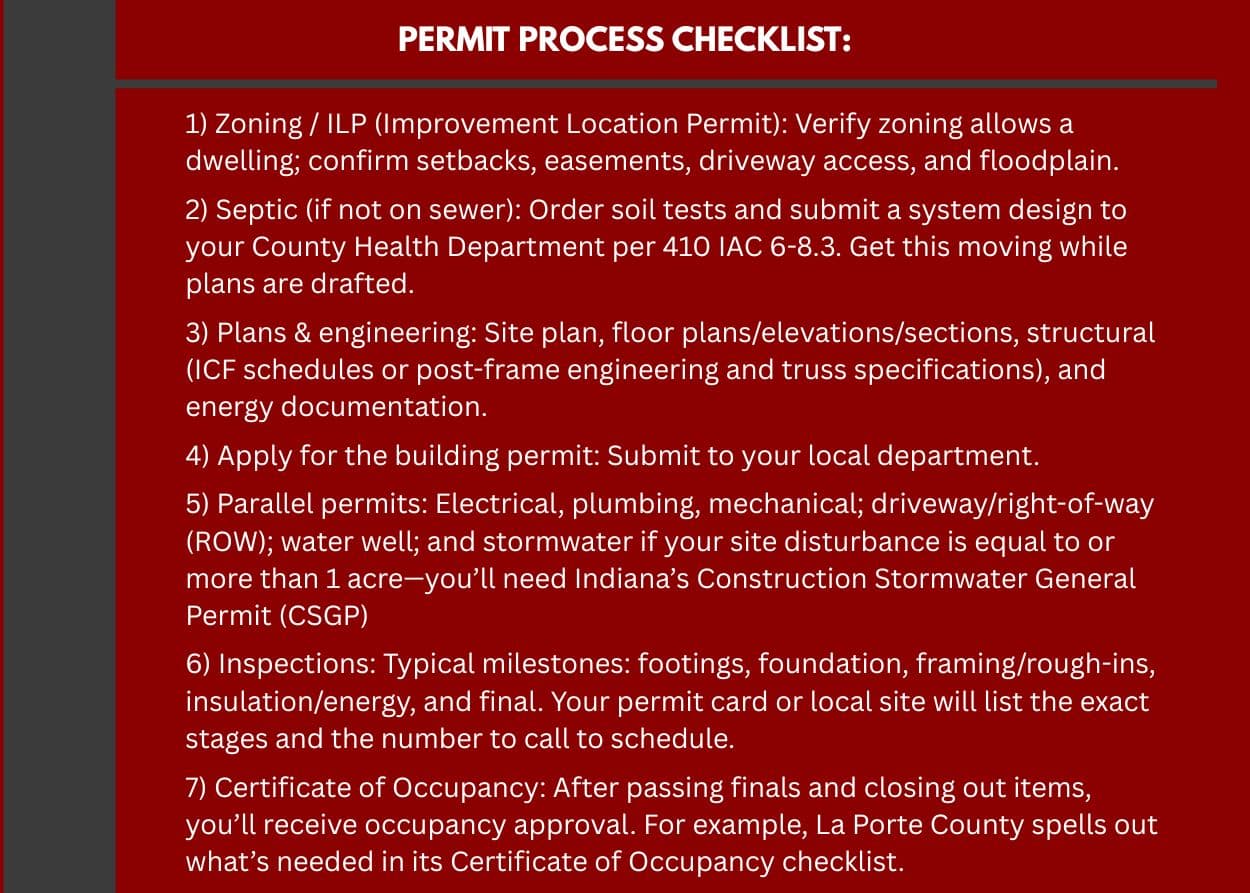
North-Central Indiana: The Permit Path (a simple checklist)
To break it down, here’s a simple checklist on what a typical permit process looks like for North-Central Indiana. Always confirm with your local permitting authorities, but typically, the sequence of permits needed for the North-Central Indiana goes like this:
1) Zoning / ILP (Improvement Location Permit): Verify zoning allows a dwelling; confirm setbacks, easements, driveway access, and floodplain.
2) Septic (if not on sewer): Order soil tests and submit a system design to your County Health Department per 410 IAC 6-8.3. Get this moving while plans are drafted.
3) Plans & engineering: Site plan, floor plans/elevations/sections, structural (ICF schedules or post-frame engineering and truss specifications), and energy documentation.
4) Apply for the building permit: Submit to your local department.
5) Parallel permits: Electrical, plumbing, mechanical; driveway/right-of-way (ROW); water well; and stormwater if your site disturbance is equal to or more than 1 acre—you’ll need Indiana’s Construction Stormwater General Permit (CSGP)
6) Inspections: Typical milestones: footings, foundation, framing/rough-ins, insulation/energy, and final. Your permit card or local site will list the exact stages and the number to call to schedule.
7) Certificate of Occupancy: After passing finals and closing out items, you’ll receive occupancy approval. For example, La Porte County spells out what’s needed in its Certificate of Occupancy checklist.
Common Approval Killers In Our Region (and easy fixes)
It’s incredibly frustrating to spend time and effort putting a permit application packet together, only to get it rejected. Here are some common gotchas that tend to trip people up at the permit office:
- Calling a dwelling a “barn.” If people will sleep there, it’s a house. Use residential forms, plans, and engineering. Many local portals and department pages make this distinction.
- Starting septic too late. County Health timelines under 410 IAC 6-8.3 can outrun your building review—start as early as possible.
- Missing energy paperwork. Conditioned space requires energy compliance docs at plan review and inspection.
- Skipping ILP or zoning sign-off. In cities like Kokomo, the ILP precedes the building permit, so make be sure to check on the sequence of permits required.
- Not using engineered details for ICF/post-frame. Bring stamped calculations/notes with your application.
- Forgetting stormwater when disturbing ≥ 1 acre. Indiana now uses CSGP; ignoring it can halt your site work.
Don’t forget a few extras depending on whether you’re building ICF or post-frame:
For ICF homes
- Stamped rebar schedules and connection details for footing and roof.
- Energy documentation. While ICF makes compliance easier, document it thoroughly anyway. It’s better to be overprepared than underprepared.
- Coordinate pre-pour inspections with your local office.
For Pole Barn homes
- Confirm it’s filed as a dwelling—not ag storage.
- Provide foundation details meeting local frost protection.
- Include engineered post-frame calculations, so that your permitting office can inspect and sign off on the structure’s safety.
- Include energy paperwork for conditioned space. You must get all of your ducks in a row to ensure that everything is checked off the list promptly. Don’t try to cut corners here. Even if you get away with it now, it’ll come back to haunt you when it’s time to sell the home or make improvements.
State References You’ll Actually Use
As much as we’ve tried to cover what you need for your permit, it’s always advisable to take a more comprehensive look, as all construction projects are unique. Here are a few state references to check if you want more info, or if you need some bedtime reading material.
- Indiana construction stormwater (CSGP) – replaces Rule 5 (2021). Check this if you’ll be disturbing an acre or more of land.
- Residential septic (410 IAC 6-8.3) – County health departments use this rule for septic systems.
- Indiana code adoption portal (ICC/IDHS) – residential/fire/building rules & updates.
How We Help in North-Central Indiana
As you can see, the permitting process isn’t very straightforward, and is a lot of work, but remember—the permitting process is there to keep you and your investment safe. It’s certainly intimidating and definitely time-consuming. And that’s why we’re happy to do this for you when we build your home.
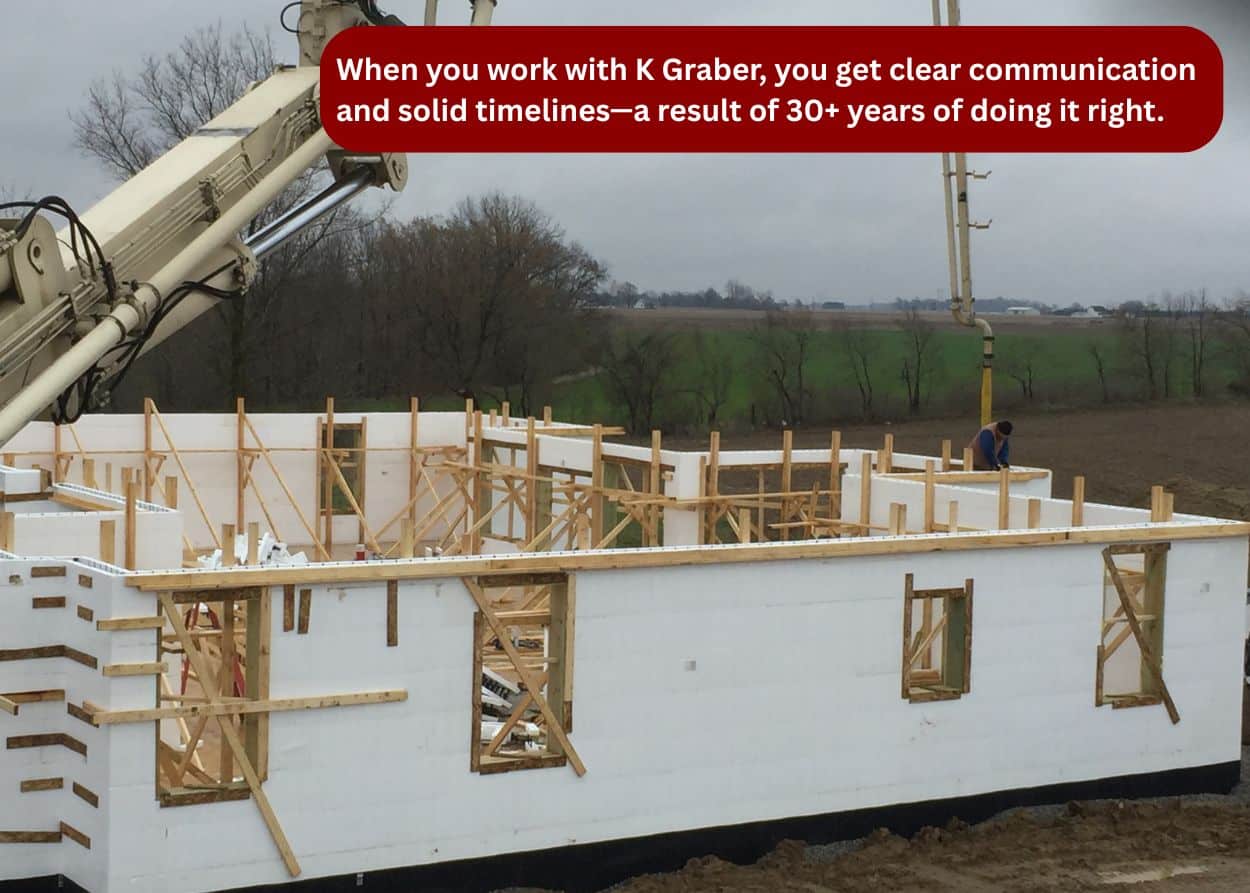
At K. Graber Construction, this is our backyard—Miami, Cass, Grant, Wabash, Howard and nearby counties. We coordinate with your local departments, assemble plan sets/engineering, line up septic and CSGP needs when they apply, and keep inspections on schedule. When you work with K Graber, you get clear communication and solid timelines—a result of 30+ years of doing it right.
Contact us today and let’s talk about how we can build your dream ICF or pole barn home—and let us handle your permits.